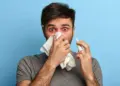
Have you ever woken up, looked in the mirror, and noticed a red rash forming around your mouth? It feels dry, flaky, slightly swollen, and sometimes itchy. When you scratch it, it burns. In some cases, it doesn’t stop at the mouth, it spreads toward the nose or even around the eyes.
Most people immediately blame acne or a sudden allergy. Some are told it’s because of steroid creams. But here’s something that surprises many patients that even habits like chewing gum or using certain toothpaste can trigger it.
To clear the confusion once and for all, let’s properly understand perioral dermatitis, what causes it, what it looks like, and most importantly, what actually works to treat it.
What Exactly Is Perioral Dermatitis?
Perioral dermatitis[1] is a chronic inflammatory skin condition that mainly affects the area around the mouth. Despite its acne-like appearance, it is not acne.
According to dermatology references used by the National Institutes of Health (NIH), this condition presents as clusters of small, inflamed bumps called papules, often surrounded by dry, flaky skin. The rash usually spares the thin border right next to the lips, which is one of the clues that helps doctors identify it.
Some people experience itching or burning, while others mainly notice tightness and discomfort especially while eating, talking, or opening their mouth.
What Does Perioral Dermatitis Look Like?
Perioral dermatitis typically appears as:
- Red or pink bumps around the mouth
- Dry, scaly, or flaky skin
- Mild swelling and inflammation
- A burning or stinging sensation
- Occasional itching
It can also spread to:
- The sides of the nose
- The area around the eyes (called periocular dermatitis)
This is why it’s often confused with acne, rosacea[2], or eczema[3] but the treatment is very different.
Types of Perioral Dermatitis
There are a few recognized forms of this condition. They are closely related but can look slightly different.
1. Classic Perioral Dermatitis
This is the most common form, with red inflamed papules around the mouth.
2. Granulomatous Perioral Dermatitis
In this type, the bumps appear yellowish or skin-colored instead of red.
- More commonly seen in children
- Often less scaly but deeper and firmer
Where Does Perioral Dermatitis Usually Occur?
As the name suggests, the most common location is around the mouth. However, it may also appear:
- Around the nostrils
- On the eyelids
- Near the eyes
Rarely, it may spread to areas like the scalp, ears, or genital region, but these cases are uncommon.
Who Is Most at Risk?
Perioral dermatitis can affect anyone, but it is most commonly seen in:
- Women between 25 and 45 years of age
- People using topical steroid[4] creams on the face
- Individuals using inhaled or nasal steroid sprays
- Children and men (less common but possible)
Symptoms of Perioral Dermatitis (NIH-Recognized)
Based on dermatology literature referenced by the NIH, common symptoms include:
- Red or flesh-colored papules around the mouth
- Dry, flaky, or peeling skin
- Burning or stinging sensation
- Tightness around the mouth
- Mild itching (not always present)
- Rash that worsens with steroid use
Unlike acne, blackheads and whiteheads are usually absent.
What Causes Perioral Dermatitis?
There is no single confirmed cause, but several contributing factors are well documented.
1. Topical Steroid Use
This is the most common trigger. Even mild steroid creams used for dryness or irritation can cause or worsen perioral dermatitis.
2. Toothpaste and Chewing Gum
Fluorinated toothpaste, artificial sweeteners, and flavoring agents found in chewing gum may irritate the skin around the mouth and disrupt the skin barrier.
3. Heavy Face Creams and Moisturizers
Overuse of thick creams can trap bacteria and disturb the skin’s natural balance.
4. Hormonal Changes
Hormonal fluctuations can make the skin more reactive and prone to inflammation.
5. Altered Skin Microflora
Changes in normal skin bacteria or yeast (including Candida species[5] or Demodex mites[6]) are suspected contributors, but this does not make it a proven fungal infection.
What Actually Works to Treat Perioral Dermatitis?
1. Stop Steroids
Stopping topical steroids is essential, but it should be done slowly and under medical supervision, as sudden withdrawal can worsen symptoms.
2. Simplify Your Skincare
This is often called “zero therapy.”
- Stop heavy creams
- Avoid harsh cleansers
- Use gentle, fragrance-free products
3. Prescription Topical Treatments
Dermatologists often prescribe:
- Metronidazole[7] gel or cream
- Azelaic acid[8]
- Clindamycin[9] or erythromycin[10]
These help reduce inflammation and control bacterial imbalance.
4. Oral Antibiotics (If Severe)
For persistent or widespread cases, oral antibiotics like doxycycline[11] or minocycline[12] may be used for a short duration.
5. Avoid Triggers
- Switch to non-fluorinated toothpaste
- Avoid chewing gum
- Stop using cosmetic products around the mouth
Final Thoughts
Perioral dermatitis can be frustrating, especially because it often looks worse before it gets better. The key thing to remember is this: more products don’t mean faster healing. In fact, less is usually more.
With proper diagnosis, patience, and the right medical guidance, this condition is completely manageable and in most cases, fully treatable.
FAQs
Q1. Is perioral dermatitis contagious?
No, it is not contagious.
Q2. Is it a fungal infection?
Not proven. While yeast involvement has been suggested, there is no confirmed single infectious cause.
Q3. Can it come back?
Yes, especially if triggers like steroid creams are reused.
Q4. How long does it take to heal?
Most cases improve within 4-8 weeks with proper treatment.
Q5. Should I see a doctor?
Yes. If the rash persists, spreads, or burns, a dermatologist should be consulted.
You can also read: How to Cure Mouth Ulcers Fast Naturally: Home Remedies That Actually Work
References
We value truthful content. 12 sources were referenced during research to write this content.
- Tempark, T., & Shwayder, T. A. (2014, March 13). Perioral Dermatitis: A Review of the Condition with Special Attention to Treatment Options. American Journal of Clinical Dermatology. Springer Science and Business Media LLC. http://doi.org/10.1007/s40257-014-0067-7
- Sand, M., Sand, D., Thrandorf, C., Paech, V., Altmeyer, P., & Bechara, F. G. (2010, June 4). Cutaneous lesions of the nose. Head & Face Medicine. Springer Science and Business Media LLC. http://doi.org/10.1186/1746-160x-6-7
- McAleer, M. A., Flohr, C., & Irvine, A. D. (2012, July 23). Management of difficult and severe eczema in childhood. Bmj. BMJ. http://doi.org/10.1136/bmj.e4770
- Coondoo, A., Phiske, M., Verma, S., & Lahiri, K. (2014). Side-effects of topical steroids: A long overdue revisit. Indian Dermatology Online Journal. Ovid Technologies (Wolters Kluwer Health). http://doi.org/10.4103/2229-5178.142483
- Manolakaki, D., Velmahos, G., Kourkoumpetis, T., Chang, Y., Alam, H. B., De Moya, M. M., & Mylonakis, E. (2010, September). Candidainfection and colonization among trauma patients. Virulence. Informa UK Limited. http://doi.org/10.4161/viru.1.5.12796
- Rather, P., & Hassan, I. (2014). Human Demodex Mite: The Versatile Mite of Dermatological Importance. Indian Journal of Dermatology. Ovid Technologies (Wolters Kluwer Health). http://doi.org/10.4103/0019-5154.123498
- McDonald, L. C., Gerding, D. N., Johnson, S., Bakken, J. S., Carroll, K. C., Coffin, S. E., … Wilcox, M. H. (2018, February 15). Clinical Practice Guidelines for Clostridium difficile Infection in Adults and Children: 2017 Update by the Infectious Diseases Society of America (IDSA) and Society for Healthcare Epidemiology of America (SHEA). Clinical Infectious Diseases. Oxford University Press (OUP). http://doi.org/10.1093/cid/cix1085
- Bretti, C., Crea, F., Foti, C., & Sammartano, S. (2006, August 4). Solubility and Activity Coefficients of Acidic and Basic Nonelectrolytes in Aqueous Salt Solutions. 2. Solubility and Activity Coefficients of Suberic, Azelaic, and Sebacic Acids in NaCl(aq), (CH3)4NCl(aq), and (C2H5)4NI(aq) at Different Ionic Strengths and att= 25 °C. Journal of Chemical & Engineering Data. American Chemical Society (ACS). http://doi.org/10.1021/je060132t
- Daum, R. S. (2007, July 26). Skin and Soft-Tissue Infections Caused by Methicillin-ResistantStaphylococcus aureus. New England Journal of Medicine. Massachusetts Medical Society. http://doi.org/10.1056/nejmcp070747
- Camilleri, M., Parkman, H. P., Shafi, M. A., Abell, T. L., & Gerson, L. (2013, January). Clinical Guideline: Management of Gastroparesis. American Journal of Gastroenterology. Ovid Technologies (Wolters Kluwer Health). http://doi.org/10.1038/ajg.2012.373
- Nelson, M. L., & Levy, S. B. (2011, December). The history of the tetracyclines. Annals of the New York Academy of Sciences. Wiley. http://doi.org/10.1111/j.1749-6632.2011.06354.x
- Reynolds, R. V., Yeung, H., Cheng, C. E., Cook-Bolden, F., Desai, S. R., Druby, K. M., … Barbieri, J. S. (2024, May). Guidelines of care for the management of acne vulgaris. Journal of the American Academy of Dermatology. Elsevier BV. http://doi.org/10.1016/j.jaad.2023.12.017