Many people look for ways to improve the appearance of their breasts without undergoing surgery. Surgical breast augmentation can involve risks, long recovery times, and permanent changes something not everyone is comfortable with. Because of this, non-surgical cosmetic treatments have gained popularity on social media, including a procedure often called the Vampire Breast Lift.
You may have seen influencers or celebrities mention it on platforms like Instagram, Tik-Tok, or YouTube. But what exactly is a vampire breast lift, and does it really work? Let’s know more about this procedure.
What Is a Vampire Breast Lift?
A Vampire Breast Lift is a non-surgical cosmetic procedure that uses Platelet-Rich Plasma[1] (PRP) derived from your own blood. It is also known as a PRP breast treatment. Unlike breast augmentation surgery, this procedure does not involve implants[2], fat transfer, or surgery. Instead, PRP is injected into specific areas of the breasts with the goal of improving skin quality and appearance, not dramatically increasing size.
What Is Platelet-Rich Plasma (PRP)?
Platelet-Rich Plasma comes from your own blood and contains a high concentration of platelets. Platelets are rich in growth factors, which play a role in:
- Tissue repair
- Collagen production
- Skin regeneration
How PRP Is Prepared
At first a small amount of blood is taken from your arm and then the blood is placed into a centrifuge, which spins at high speed. This process separates the blood into components:
- Red blood cells[3]
- White blood cells[4]
- Platelet-rich plasma (PRP)
The PRP is then injected into targeted areas of the breast because PRP comes from your own body, the risk of allergic reaction is low.
Why Do People Choose a Vampire Breast Lift?
People who opt for this procedure usually want subtle cosmetic improvement, not a dramatic size increase. Providers claim PRP may help:
- Improve skin texture and tone
- Enhance firmness slightly
- Improve cleavage[5] appearance
- Reduce the appearance of fine lines or stretch marks on the chest
- Improve overall skin glow and elasticity
PRP is believed to stimulate collagen[6] and elastin[7] production, which can make the skin look healthier and more youthful.
Does a Vampire Breast Lift Increase Breast Size?
Don’t rely on social media posts to know about vampire breast lift because they tend to exaggerate. The fact is that a vampire breast lift does not significantly increase the breast size and secondly it does not replace breast implants.
Some people may notice a very mild, temporary fullness due to swelling or improved skin quality, but there is no scientific evidence proving permanent breast enlargement from PRP alone. Major medical organizations, including dermatology and plastic surgery associations, emphasize that PRP results are subtle and cosmetic, not structural.
Is There Scientific Evidence That It Works?
At present:
- There are limited clinical studies on PRP for breast enhancement.
- PRP is widely used in dermatology, orthopedics, and hair restoration.
- Its use in breast aesthetics is considered off-label and cosmetic.
This means:
- Some people report improvement in skin appearance.
- Results vary from person to person.
- Long-term, large-scale studies are still lacking.
What Happens Before the Procedure?
Before undergoing a PRP breast treatment, you will have a consultation with a qualified dermatologist or plastic surgeon. During this consultation:
- Your medical history is reviewed
- Breast health is examined
- Existing conditions (such as clotting disorders) are ruled out
- Realistic expectations are discussed
You may be advised to avoid:
for about a week before the procedure, as they can interfere with platelet function.
What Happens During and After the Treatment?
- The procedure usually takes 30-60 minutes
- Mild discomfort during injections may occur
- No general anesthesia is required
Possible Temporary Side Effects
Some people may experience:
- Mild swelling
- Bruising
- Tenderness
- Redness at injection sites
These effects typically resolve within a few days.
Recovery Time and Results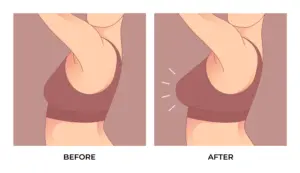
- Most people return to normal activities within 1-2 days
- Initial skin improvement may appear within 3-4 weeks
- Full results may take 2-3 months
- Results can last up to 1-2 years, depending on individual factors
Who Should NOT Get a Vampire Breast Lift?
This procedure is not recommended for individuals who:
- Have current or past breast cancer
- Are pregnant or breastfeeding
- Have blood disorders or platelet dysfunction
- Have active infections in the breast area
Always consult a certified medical professional before proceeding.
When Should You Contact a Doctor?
Seek medical attention if you experience:
- Excessive or persistent bleeding
- Severe pain
- Swelling or bruising that does not improve
- Signs of infection (fever, warmth, pus)
Final Thoughts
A vampire breast lift is a non-surgical cosmetic procedure that may improve the appearance and skin quality of the breasts, but it is not a proven method for significant breast enlargement.
While PRP is generally considered safe when performed by trained professionals, results vary, and expectations should remain realistic. Always rely on certified dermatologists or plastic surgeons, not social media trends, when making medical decisions.
Frequently Asked Questions (FAQ)
Q1. Is a vampire breast lift safe?
When performed by a qualified medical professional, PRP treatments are generally safe. However, no cosmetic procedure is completely risk-free.
Q2. Can PRP permanently increase breast size?
No. There is no scientific evidence that PRP can permanently increase breast size.
Q3. How long do results last?
Results may last between 12-24 months, depending on skin condition, age, and lifestyle.
Q4. Is PRP approved by the FDA?
PRP itself is allowed for medical use, but its use for breast enhancement is considered off-label, meaning it is not specifically FDA-approved for this purpose.
Q5. How many sessions are required?
Most providers recommend one session, but some may suggest follow-up treatments based on individual goals.
While a Vampire Breast Lift focuses on non-surgical breast enhancement, you can also read our blog What Does BBL Mean? Everything You Need to Know to understand how body contouring procedures differ.
References
We value truthful content. 9 sources were referenced during research to write this content.
- Xu, Q., Chen, J., & Cheng, L. (2019, July). Comparison of platelet rich plasma and corticosteroids in the management of lateral epicondylitis: A meta-analysis of randomized controlled trials. International Journal of Surgery. Ovid Technologies (Wolters Kluwer Health). http://doi.org/10.1016/j.ijsu.2019.05.003
- Thomas, D., & Singh, D. (2017, June). 3D printing in surgery – The evolving paradigm-shift in surgical implants on demand. International Journal of Surgery. Ovid Technologies (Wolters Kluwer Health). http://doi.org/10.1016/j.ijsu.2017.04.027
- D'Alessandro, A., Dzieciatkowska, M., Nemkov, T., & Hansen, K. C. (2017). Red blood cell proteomics update: is there more to discover? [JB]. Blood Transfusion. http://doi.org/10.2450/2017.0293-16
- (2014). Medical gallery of Blausen Medical 2014. WikiJournal of Medicine. Wikiversity Journal of Medicine. http://doi.org/10.15347/wjm/2014.010
- Kolker, A. R., & Collins, M. S. (2015, August). Reply. Plastic and Reconstructive Surgery. Ovid Technologies (Wolters Kluwer Health). http://doi.org/10.1097/prs.0000000000001429
- Shoulders, M. D., & Raines, R. T. (2009, June 1). Collagen Structure and Stability. Annual Review of Biochemistry. Annual Reviews. http://doi.org/10.1146/annurev.biochem.77.032207.120833
- Mithieux, S. M., & Weiss, A. S. (2005). Elastin. Advances in Protein Chemistry. Elsevier. http://doi.org/10.1016/s0065-3233(05)70013-9
- Mahdi, J. G. (2014, December). Biosynthesis and metabolism of β-d-salicin: A novel molecule that exerts biological function in humans and plants. Biotechnology Reports. Elsevier BV. http://doi.org/10.1016/j.btre.2014.08.005
- Mallinson, T. E. (2017, December 2). A review of ketorolac as a prehospital analgesic. Journal of Paramedic Practice. Mark Allen Group. http://doi.org/10.12968/jpar.2017.9.12.522