Have you ever wondered while watching yourself in the mirror whether you can do facial exercise which can help contouring the jaw the same way you exercise to get abs or arms. Well there are many jaw exercises, chewing gum, and face workouts available everywhere on social media, all promising a sharper jawline and a more defined face. But can you actually train your masseter muscle for a better jaw or is it mostly a myth? Let’s talk about what really happens.
What Is the Masseter Muscle?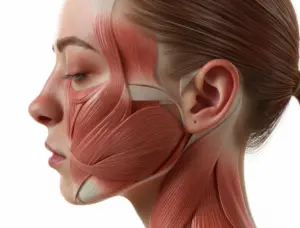
The masseter[1] is the muscle on the side of your face. It connects your cheekbone to your lower jaw and helps in allowing chewing, clenching, and grinding.
It’s a muscle that plays a role in handling constant movement every time you eat. Because of this, it can become tense, especially in people who clench[2] their teeth or grind at night.
Can You Actually Train the Masseter?
You can train the masseter by doing particular jaw exercises but overtraining this muscle sometime can do the opposite. So better to be cautious.
Why Training the Masseter Doesn’t Always Improve Jaw Shape
When a muscle is used repeatedly, it grows. The masseter is no different. The exercise can define your jaw but if you constantly chew gum, do aggressive jaw exercises and clench your jaw intentionally it can lead to a wider or more square looking lower face. The muscles will become bulkier than before. This is why some people go for masseter botox[3] to avoid such risks.
What Jaw Exercises Can and Can’t Do
Jaw exercises can help in:
- Improving jaw awareness
- Reducing mild stiffness
- Supporting jaw mobility
- Relaxation if focused on stretching rather than strengthening
Jaw exercises cannot help in:
- Burn fat from the face
- Create bone definition
- Sharply sculpt your jawline
- Replace medical treatment for jaw disorders
Your jawline shape is influenced by bone structure, fat distribution, muscle size and skin elasticity. Exercises alone can’t change most of these factors.
For medical and cosmetic solutions, see our complete guide on Masseter Botox Treatment: Everything You Need to Know.
The Chewing Gum Myth
Chewing gum is often promoted as a jaw workout. While it does activate the masseter, excessive gum chewing can:
- Increase jaw tension
- Worsen teeth grinding
- Trigger jaw pain or TMJ[4] symptoms
- Make the face appear wider over time
For people prone to clenching or Temporomandibular joint dysfunction (TMD), frequent gum chewing may do more harm than good.
When Training the Masseter Is Actually a Bad Idea
You should avoid strengthening the masseter if you:
- Grind or clench your teeth
- Have jaw pain or headaches
- Have TMD symptoms
- Want a slimmer jawline
In these cases, the goal is relaxation, not activation.
What Actually Helps Create a Better Jaw Appearance?
If by better jaw you mean more balanced and defined, here’s what realistically helps:
1. Overall Fat Loss
Face fat loss can be achieved by losing overall body weight as there is no exercise alone that can make your face look slimmer.
2. Posture and Neck Alignment
Poor posture can make the jawline look softer. Improving neck and head alignment can subtly improve appearance.
3. Medical Options (If Needed)
- Masseter Botox for bulky jaw muscles
- Orthodontic[5] correction for bite issues
- Professional evaluation for TMJ disorders
Final Thoughts
Your jawline isn’t something that needs fixing. Strong masseter muscles are often a sign of stress, clenching, or overuse not weakness. If you’re chasing jaw exercises because social media told you a perfect jaw equals beauty, then you need to stop right there. Because a better jaw isn’t about forcing muscles to grow but it’s about balance, comfort, and confidence.
FAQs
Q1. Can jaw exercises give me a sharp jawline?
Not always. Jawline definition depends more on bone structure and fat distribution.
Q2. Does chewing gum help jaw definition?
It strengthens the masseter but may make the jaw look wider, not sharper.
Q3. Is masseter Botox better than exercises?
For people with bulky jaw muscles, clenching, or TMD, Botox is often more effective.
Q4. Can overtraining the jaw cause problems?
Yes. It can lead to jaw pain, headaches, and TMJ issues.
Q5. Should I see a doctor for jaw concerns?
If you have pain, grinding, or locking, professional evaluation is recommended.
If you experience jaw pain or tightness while doing exercises, read MJ Trigger Points: Causes, Symptoms, and Treatment to understand how muscle knots can affect the masseter.
References
We value truthful content. 5 sources were referenced during research to write this content.
- Mezey, S. E., Müller-Gerbl, M., Toranelli, M., & Türp, J. C. (2022, February). The human masseter muscle revisited: First description of its coronoid part. Annals of Anatomy - Anatomischer Anzeiger. Elsevier BV. http://doi.org/10.1016/j.aanat.2021.151879
- Klasser, G. D., & Balasubramaniam, R. (2015). Sleep Bruxism: What Orthodontists Need to Know?. TMD and Orthodontics. Springer International Publishing. http://doi.org/10.1007/978-3-319-19782-1_5
- Park, S. (2017, June 14). The Standard Mandible Reduction with Intraoral Approach. Facial Bone Contouring Surgery. Springer Singapore. http://doi.org/10.1007/978-981-10-2726-0_6
- Nozawa-Inoue, K., Amizuka, N., Ikeda, N., Suzuki, A., Kawano, Y., & Maeda, T. (2003). Synovial membrane in the temporomandibular joint-Its morphology, function and development. Archives of Histology and Cytology. International Society of Histology & Cytology. http://doi.org/10.1679/aohc.66.289
- Lombardo, G., Vena, F., Negri, P., Pagano, S., Barilotti, C., Paglia, L., … Cianetti, S. (2020). Worldwide prevalence of malocclusion in the different stages of dentition: A systematic review and meta-analysis [JB]. European Journal of Paediatric Dentistry, 21(2), 115–123. http://doi.org/10.23804/ejpd.2020.21.02.05